
The hierarchy of risk control is a core concept in workplace health and safety, but its real value is in application, not theory. Knowing the levels is one thing; using them on a busy construction site or factory floor is another challenge. This guide provides practical hierarchy of risk control examples for high-risk industries like manufacturing and construction. We will break down each control level, from the most effective (elimination) to the last line of defense (PPE).
This article is for safety managers, site supervisors, and business owners who need more than a checklist. You will find industry-specific examples, clear ways to use them, common mistakes to avoid, and simple methods to check if your controls are working. The goal is a clear, operational roadmap for reducing workplace risk. We will focus on what you can put in place on-site, starting today, to create a safer working environment. This is about putting proven safety principles into practice in a way that is both effective and sustainable.
1. Elimination (Remove the Hazard)
At the top of the hierarchy of controls, elimination is the most effective method. It involves completely removing a hazard from the workplace. Instead of creating processes to manage risk, you redesign the work so the risk no longer exists. This approach provides the highest level of protection because a hazard that isn't there cannot cause harm.
For industries like manufacturing and construction, physically removing a danger permanently reduces the need for ongoing training, personal protective equipment (PPE), and administrative oversight for that hazard. This not only makes the workplace safer but also leads to long-term cost savings by preventing incidents before they can happen.
Example in Focus: Automated Material Handling
A large manufacturing plant faced constant musculoskeletal injuries from manual handling. Workers had to lift and move heavy components from the production line to the packing area, a repetitive and physically demanding task.
- The Hazard: Manual handling of heavy objects, leading to a high rate of sprains, strains, and chronic back injuries.
- The Control: The company invested in an automated conveyor and robotic palletizing system. The new system moved finished components directly from the production line to a robotic arm that stacked them onto pallets for shipping.
- The Outcome: The need for manual lifting was completely removed. This eliminated the primary cause of musculoskeletal injuries in that part of the plant, resulting in a 90% reduction in related injury claims within the first year.
Strategic Insight: Elimination often requires an initial capital investment, but the return is substantial. It's calculated not just on productivity gains but also on avoided costs, including workers' compensation claims, lost workdays, and the administrative burden of managing incidents.
How to Apply Elimination Effectively
Putting elimination controls in place requires a systematic approach. It starts with a detailed analysis of your work processes to find opportunities where hazards can be engineered out of existence.
Actionable Takeaways:
- Conduct a Thorough Hazard Hunt: The first step is a complete risk assessment process that specifically looks for elimination opportunities. Don't just identify hazards; question why the hazard exists in the process at all.
- Involve Frontline Teams: Talk with workers, engineers, and maintenance staff. They have firsthand knowledge of the tasks and can often identify the most practical ways to remove a hazard.
- Focus on Design and Procurement: Use elimination at the design or purchasing stage. For example, choose to purchase pre-fabricated building components to avoid high-risk on-site assembly work or select equipment that doesn't produce harmful noise levels.
- Measure Before and After: Document conditions before making a change. Track metrics like injury rates, near misses, and worker feedback. This data provides clear evidence of the control's effectiveness and justifies the investment.
- Plan the Transition: For major changes like automation, plan a gradual rollout. This reduces operational disruption and allows time to train staff on the new, safer procedures before the old hazardous process is fully decommissioned.
2. Substitution (Replace with Safer Alternative)
The second most effective method in the hierarchy of controls is substitution. This strategy involves replacing a hazardous material, piece of equipment, or work process with a less dangerous alternative that performs the same function. It is a powerful control because it reduces the severity of a hazard, even if it doesn't remove it entirely.
For sectors like construction and manufacturing, substitution is often a more practical and affordable option than complete elimination. It allows operations to continue while lowering the risk. By choosing a safer chemical, tool, or material, organizations can reduce the potential for serious injury or long-term health issues without a complete process overhaul.
Example in Focus: Switching from Solvent to Water-Based Paints
A commercial vehicle body shop regularly used high-VOC (volatile organic compound) solvent-based paints for finishing. This process exposed workers to harmful fumes, creating risks of respiratory illnesses, skin irritation, and central nervous system effects. It also posed a fire hazard.
- The Hazard: Exposure to toxic chemical fumes from solvent-based paints and a high risk of fire or explosion from flammable vapors.
- The Control: The company researched and switched to modern water-based acrylic paints. These newer formulas offered a comparable finish but contained much lower levels of VOCs, making them less toxic and non-flammable.
- The Outcome: The switch immediately reduced airborne contaminants in the workshop, improving air quality. It eliminated the primary fire risk and reduced the need for expensive, specialized ventilation systems. The company also recorded a 75% decrease in worker complaints related to headaches and respiratory irritation.
Strategic Insight: Substitution addresses the root cause of the hazard by replacing it. The upfront cost of testing and finding alternatives is often offset by reduced spending on complex engineering controls (like ventilation), specialized PPE, and health monitoring programs.
How to Apply Substitution Effectively
Using substitution requires careful evaluation to make sure the replacement doesn't introduce new, unexpected hazards. A structured approach ensures the change results in a net safety improvement.
Actionable Takeaways:
- Review Your Chemical Inventory: Start by looking at your Safety Data Sheets (SDS). Identify the most hazardous substances in use (e.g., carcinogens, highly flammable liquids) and prioritize them for substitution.
- Engage with Suppliers: Your suppliers are a valuable resource. Ask them about safer, alternative products for your applications. They often have technical data to compare the performance and risk of different options.
- Conduct a Comparative Risk Assessment: Before committing to a change, formally assess the old process against the new one. Consider all potential impacts, such as chemical reactivity, needed equipment changes, and new training needs.
- Pilot Test the Substitute: Run a small-scale trial of the new material or process in a controlled environment. This lets you check its performance and identify any practical issues before a full-scale rollout. Involve the workers who will use it to get direct feedback.
- Update All Documentation and Training: Once a substitution is approved, update all relevant documents, including risk assessments, safe work procedures, and emergency plans. Make sure all affected workers are trained on the new material’s specific handling requirements.
3. Engineering Controls (Isolation and Protection)
Positioned as the third level in the hierarchy of controls, engineering controls physically separate workers from hazards. Instead of changing work practices, this approach involves redesigning equipment, processes, or the work environment to make them safer. These controls are built-in safety features that operate without needing human action.
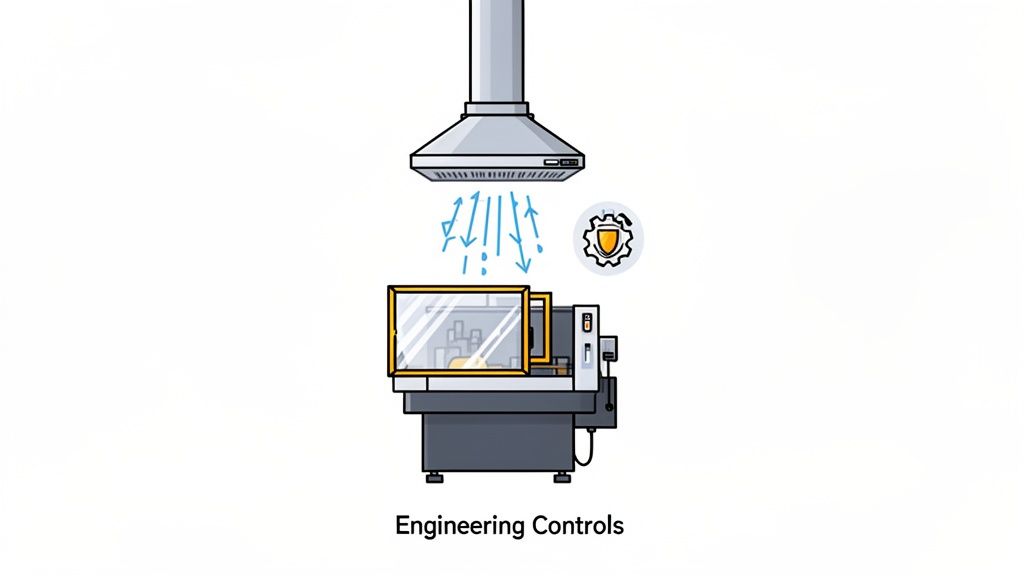
For industries like construction and manufacturing, engineering controls provide a high degree of protection by placing a physical barrier or system between a worker and a hazard. Examples include machine guards, local exhaust ventilation (LEV), and fall prevention systems. They are generally more reliable than administrative controls or PPE because they are designed to function continuously without direct human input.
Example in Focus: Fume Extraction for Welding Bays
A heavy fabrication workshop was dealing with high levels of welding fumes in its welding bays. The existing general ventilation was not enough, leading to poor air quality, health complaints from workers, and risks of long-term respiratory illnesses.
- The Hazard: Inhalation of toxic welding fumes in a semi-enclosed workspace.
- The Control: The company fitted each welding bay with a dedicated Local Exhaust Ventilation (LEV) system. This involved installing articulated extraction arms that welders could position directly over the workpiece to capture fumes at the source. The system pulled fumes through a filter before venting clean air.
- The Outcome: Air quality monitoring after installation showed a 95% reduction in airborne contaminants within the welders' breathing zones. This greatly lowered the risk of occupational lung disease and brought the workshop well within regulatory compliance standards.
Strategic Insight: Engineering controls are most effective when they address the hazard at its source. Source-capture systems, like LEV for fumes or dust extractors on saws, prevent the hazard from spreading into the general work environment, protecting not just the operator but everyone nearby.
How to Apply Engineering Controls Effectively
Successful use of engineering controls goes beyond just installing new equipment. It requires planning, maintenance, and checks to ensure the control remains effective over time.
Actionable Takeaways:
- Prioritize Source Control: When choosing a control, always favor solutions that capture or contain a hazard where it is generated. This is more effective and often more energy-efficient than diluting it with general ventilation.
- Establish a Maintenance Schedule: Engineering controls like guards and ventilation systems require regular checks. Document a preventive maintenance schedule with clear checklists for each control and make sure technicians are trained to perform inspections.
- Integrate Smart Technology: The integration of artificial intelligence in engineering controls can improve safety in high-risk environments, as shown in presentations to companies like Energy Specialists company (LSE) working in industrial and electrical networks. Smart sensors can monitor airflow in a ventilation system or detect if a machine guard has been removed, triggering an alert or an automatic shutdown.
- Involve Engineers Early: During the design and buying phases of new machinery or facilities, consult with safety and mechanical engineers. Building safety features into the initial design is much more cost-effective than adding them later.
- Train Staff on Operation and Limitations: Workers must understand how the engineering controls work, how to operate them correctly (e.g., positioning an LEV hood), and what to do if they malfunction. This training is crucial for getting the maximum protective benefit.
4. Administrative Controls (Systems, Procedures, and Training)
Administrative controls are the fourth level in the hierarchy of risk control examples. They don't remove hazards but instead change the way people work around them. This level focuses on putting in place procedures, policies, safe work practices, and training to reduce the duration, frequency, and severity of exposure to a hazard.
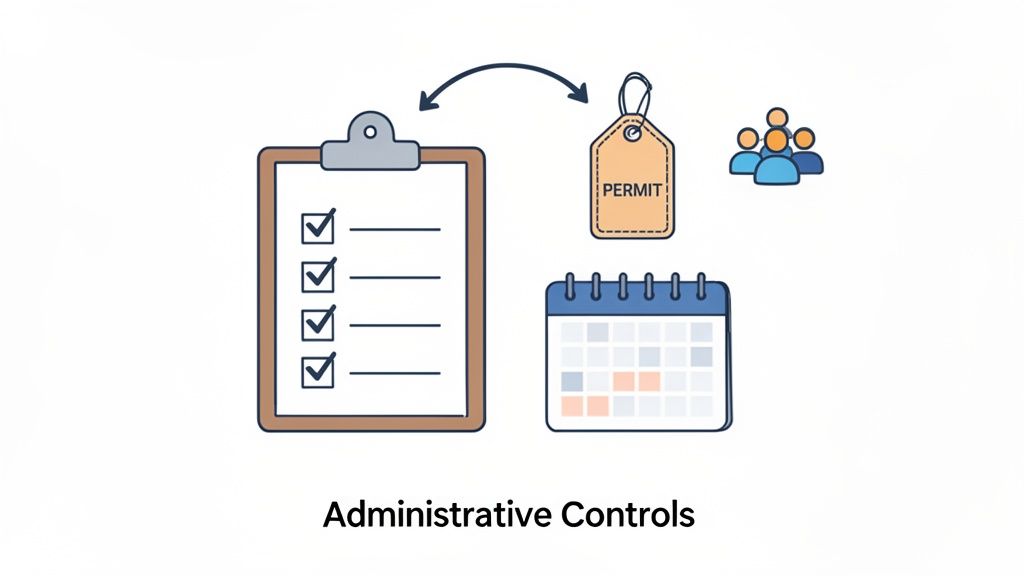
For small to medium enterprises (SMEs) and construction supervisors, these controls are often the most practical tools for managing daily risks. They are highly adaptable and can be quickly put in place to address changing site conditions or operational needs. However, their effectiveness relies entirely on consistent human action and good supervision.
Example in Focus: Confined Space Entry Permit System
A mid-sized industrial subcontractor was hired to perform maintenance inside a large storage tank at a manufacturing facility. This task involved working in a confined space, which presented serious risks, including a hazardous atmosphere, engulfment, and limited ways to get in and out.
- The Hazard: Working inside a confined space with potential for oxygen deficiency, toxic gases, and entrapment.
- The Control: The company used a strict Permit-to-Work system for all confined space entries. The procedure required a formal risk assessment, atmospheric testing before and during entry, isolation of all energy sources (lock-out/tag-out), a designated and trained standby person, and a clear emergency rescue plan.
- The Outcome: The permit system created a formal, step-by-step process that forced the team to identify and control risks before work began. This structured approach prevented unauthorized entry and made sure all safety measures were in place, leading to the successful completion of the job with zero incidents.
Strategic Insight: Administrative controls put safety into your operations. A permit system isn't just paperwork; it’s a communication tool that confirms all stakeholders have verified the conditions are safe before high-risk work begins.
How to Apply Administrative Controls Effectively
Successful administrative controls are built on clear communication, thorough training, and consistent enforcement. They provide the rules and procedures that support higher-level engineering controls and guide the correct use of PPE.
Actionable Takeaways:
- Document Everything Clearly: Write your safe work procedures and policies in simple, direct language. Avoid jargon and use visual aids where possible. A procedure that is hard to understand will not be followed.
- Implement Role-Specific Training: Don't use a one-size-fits-all approach. Develop training that addresses the specific hazards individual workers face. For electrical work, for instance, understanding specific standards is crucial; you can find helpful guidance on What is the NFPA 70E for electrical safety protocols.
- Involve Your Team: Get your frontline workers involved in developing procedures. They know the job best and can provide practical insights that make the controls more effective and easier to follow. This also increases buy-in.
- Verify Understanding, Not Just Attendance: Training is incomplete without competency checks. Use practical demonstrations or short quizzes to confirm that workers understand and can apply the procedures correctly. This is a core part of a good health and safety management system.
- Schedule and Track Everything: Use schedules for job rotation, equipment maintenance, and refresher training. Monitor completion rates to make sure these critical administrative tasks are not missed during busy periods.
5. Personal Protective Equipment (PPE)
Personal Protective Equipment (PPE) is the final and least effective level in the hierarchy of controls. It acts as a last line of defense, designed to protect individuals from hazards that remain after higher-level controls have been used. PPE does not remove or reduce the hazard itself; instead, it creates a barrier between the worker and the hazardous energy or substance.
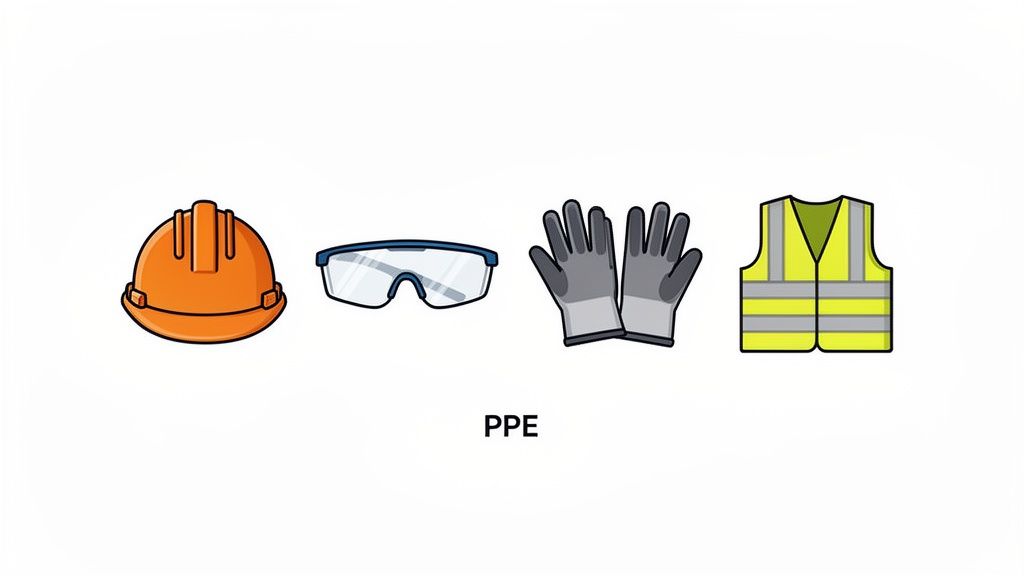
Unlike elimination or engineering controls that provide collective protection, PPE protects only the person wearing it and relies heavily on correct selection, fit, and consistent use. For high-risk industries like construction and manufacturing, PPE is often mandatory to manage remaining risks, but it should never be the primary or sole method of control where more effective options are possible. Its effectiveness is limited by human factors, such as improper wear, poor maintenance, or failure to use it at all.
Example in Focus: Welding Operations in a Fabrication Workshop
A metal fabrication workshop had a high number of eye injuries, specifically "arc eye" (photokeratitis), and minor burns among its welding team. Although extraction fans (an engineering control) were in place to manage fumes, the direct hazards from the welding arc, sparks, and hot surfaces remained.
- The Hazard: Exposure to intense ultraviolet (UV) radiation from the welding arc, flying sparks, and contact with hot metal surfaces.
- The Control: The company put in place a mandatory PPE program for all welding tasks. This included auto-darkening welding helmets with the correct shade rating, flame-resistant jackets, leather gloves, and steel-toed boots. A designated "welding bay" required all personnel entering the area to wear safety glasses with UV protection.
- The Outcome: The introduction of the complete PPE program led to a 75% reduction in reported eye injuries and burns within six months. The program’s success was tied directly to strict enforcement, regular equipment inspections, and training on the limitations of each PPE item.
Strategic Insight: The effectiveness of PPE is directly tied to its management program. It is not a "set and forget" solution. A successful program requires active supervision, consistent training, and clear protocols for maintenance and replacement to work.
How to Apply PPE Effectively
Properly managing a PPE program means treating it as a critical system, not just a box of equipment. It requires a structured approach to make sure it provides reliable protection.
Actionable Takeaways:
- Base Selection on a Risk Assessment: Don't issue generic PPE. Conduct a specific risk assessment for personal protective equipment requirements for each task to determine the exact type of protection needed (e.g., specific filter cartridge for a respirator, correct cut-level for gloves).
- Ensure Proper Fit and Worker Buy-In: Ill-fitting PPE is often not worn correctly or at all. Involve workers in the selection process to find gear that is both effective and comfortable. Conduct fit-testing for equipment like respirators.
- Establish Clear Maintenance and Replacement Schedules: PPE breaks down over time. Create a clear system for inspecting gear before each use, along with a schedule for mandatory replacement based on manufacturer recommendations or visible wear. For example, hard hats should be replaced after any significant impact.
- Train on Limitations: Workers must understand what their PPE can and cannot do. Training should cover how to correctly put on and take off equipment, how to clean and store it, and how to identify when it needs to be replaced.
- Conduct Regular Audits: Supervisors should perform regular, documented checks to verify that the correct PPE is being used properly for assigned tasks. These audits help identify gaps in training or compliance before an incident occurs.
5-Point Comparison: Hierarchy of Risk Controls
| Control Type | Implementation Complexity 🔄 | Resource Requirements & Cost 💡 | Typical Implementation Speed ⚡ | Expected Outcomes ⭐📊 | Ideal Use Cases |
|---|---|---|---|---|---|
| Elimination (Remove the Hazard) | High – major process redesign, cross-functional coordination | High – significant capital, retraining, potential operational disruption | Slow – 6–12 months | ⭐⭐⭐⭐⭐ Permanent hazard removal; highest long‑term incident reduction 📊 | When hazards can be removed/substituted; design or process overhaul |
| Substitution (Replace with Safer Alternative) | Moderate – material/process changes, supplier engagement | Moderate – new materials, training, possible supply adjustments | Medium – 3–6 months | ⭐⭐⭐⭐ Reduces severity/exposure; not full elimination 📊 | Where safer alternatives exist but elimination is impractical |
| Engineering Controls (Isolation & Protection) | Moderate–High – technical design, installation and validation | High – capital expenditure, ongoing maintenance and expertise | Medium – 2–6 months | ⭐⭐⭐⭐ Strong exposure reduction by isolation; less reliant on behavior 📊 | Controls for dust, fumes, machinery guarding, fall protection |
| Administrative Controls (Systems, Procedures, Training) | Low–Moderate – policy, procedures, scheduling and supervision | Low–Moderate – staff time, training, digital management tools | Fast – 1–3 months | ⭐⭐⭐ Reduces frequency of exposure; effectiveness depends on compliance 📊 | SMEs, temporary measures, procedural gaps, training needs |
| Personal Protective Equipment (PPE) | Low – rapid deployment; relies on individual use and fit | Low upfront – ongoing replacement, fit-testing and storage costs | Immediate – deployable immediately; ongoing management | ⭐⭐ Last line of defense; protects individuals but not the hazard source 📊 | Interim protection, specific high‑risk tasks, when higher controls not feasible |
Making Your Controls Stick: From Plan to Practice
This deep dive into the hierarchy of risk control examples has shown one thing clearly: the most effective safety management is not about any single solution. It is a systematic, multi-layered approach that prioritizes permanent fixes over temporary shields. From eliminating a trip hazard in a manufacturing facility to substituting a toxic chemical in a construction project, the goal is always to address the root cause of the risk first.
The examples provided throughout this article serve as practical blueprints. We saw how engineering controls, like machine guarding or local exhaust ventilation, provide a physical barrier between workers and hazards. We also explored how administrative controls, such as clear work procedures and robust training programs, are essential support systems, but they rely on consistent human action to be effective. Finally, we positioned Personal Protective Equipment (PPE) correctly as the last line of defense, a necessary but insufficient control when used in isolation.
Key Takeaways for Immediate Application
Moving forward, the critical challenge is to make these concepts a consistent part of your operational reality. It is not enough to simply understand the hierarchy; you must actively apply it during every risk assessment, job planning session, and incident investigation.
- Always Start at the Top: Before you even consider PPE or procedures, ask the hard questions. Can we remove this hazard completely? Can we swap this dangerous process for a safer one? This mindset shift is the single most impactful change you can make.
- Document and Verify: A control that isn't documented and regularly checked might as well not exist. For any hierarchy of risk control examples you implement, define how you will measure its effectiveness. Is the guard still in place? Is the ventilation system working to specification? Are workers following the new procedure?
- Layer Your Controls: Relying on just one control, especially from the lower end of the hierarchy, creates a fragile safety system. Combine engineering controls with supporting administrative procedures and the correct PPE. This defense-in-depth approach ensures that if one layer fails, others are still in place to protect your team.
Ultimately, mastering the hierarchy of controls moves your organization from a reactive, compliance-focused mindset to a proactive, risk-elimination one. It is about building a workplace where safety is an engineered outcome, not an afterthought. This approach not only prevents injuries and saves lives but also drives operational efficiency, reduces downtime, and builds a foundation of trust with your workforce. It is the framework that turns good intentions into tangible, protective actions on the ground, every single day.
Ready to move your safety management from scattered documents to a centralised, actionable system? Safety Space provides the tools to document your risk assessments, track control measures, and verify their effectiveness in one easy-to-use platform. See how you can apply the hierarchy of risk control examples in a smarter way by visiting Safety Space today.
Ready to Transform Your Safety Management?
Discover how Safety Space can help you implement the strategies discussed in this article.
Explore Safety Space FeaturesRelated Topics
Safety Space Features
Explore all the AI-powered features that make Safety Space the complete workplace safety solution.
Articles & Resources
Explore our complete collection of workplace safety articles, tools, and resources.