
An occupational health and safety policy is your company’s official commitment to protecting the health, safety, and wellbeing of your employees and anyone else affected by what you do. Think of it as a practical blueprint that outlines your safety goals and the responsibilities of everyone, from the top floor to the front line.
Your OHS Policy Is an Action Plan, Not Just a Document
Let's get straight to it. Your occupational health and safety policy is the operational heart of your entire safety system. It's not a document you sign once and file away; it's a living commitment that dictates how you manage risk, day in and day out.
A piece of paper doesn't stop accidents. An active, understood, and enforced policy does.
In high-stakes industries like construction and manufacturing, the gap between a written document and on-the-ground reality can have serious consequences. A clear, actionable policy is your most critical tool for preventing incidents and meeting your legal duties under Work Health and Safety (WHS) legislation.
Beyond a Compliance Document
Seeing your policy purely as a compliance checkbox is a massive mistake. It should be the central reference point for how safety is handled across your entire operation. A strong policy does a lot more than just tick a box for the regulators.
- It sets clear expectations. Every worker, supervisor, and contractor knows exactly what's expected of them when it comes to safety.
- It assigns responsibility. There’s no ambiguity. The policy clearly defines who is accountable for specific safety tasks, from providing PPE to conducting site inspections.
- It guides decision-making. When a new hazard pops up on site, your policy provides the framework for assessing and controlling that risk.
- It demonstrates commitment. A well-maintained and visible policy shows your team and regulators that safety is a core business value, not just an afterthought.
This guide skips the fluff and gets straight into what a practical occupational health and safety policy actually looks like. We'll show you how to build a document that genuinely protects your workers, whether they're on the factory floor or a construction site.
A policy is only as good as its implementation. Its real purpose is to drive actions that prevent harm, not just sit in a folder. If your team can’t explain its key points, it isn't working.
That means we'll focus on the core elements your policy must contain. We’ll cover the required clauses, how to consult with your team effectively, and how to create a document that is easily understood by everyone, no matter their role.
Drafting a Policy That Actually Works
Building an occupational health and safety policy from the ground up can feel like a massive job. But it doesn't have to be some overly complicated legal document. Your goal is to create a straightforward, practical guide that spells out your commitment and sets clear, non-negotiable rules for everyone on site.
A good policy isn't crammed with jargon. It needs to be a clear roadmap that a new apprentice can understand just as easily as a seasoned site supervisor. It should be built directly from the real-world risks your team faces every single day.
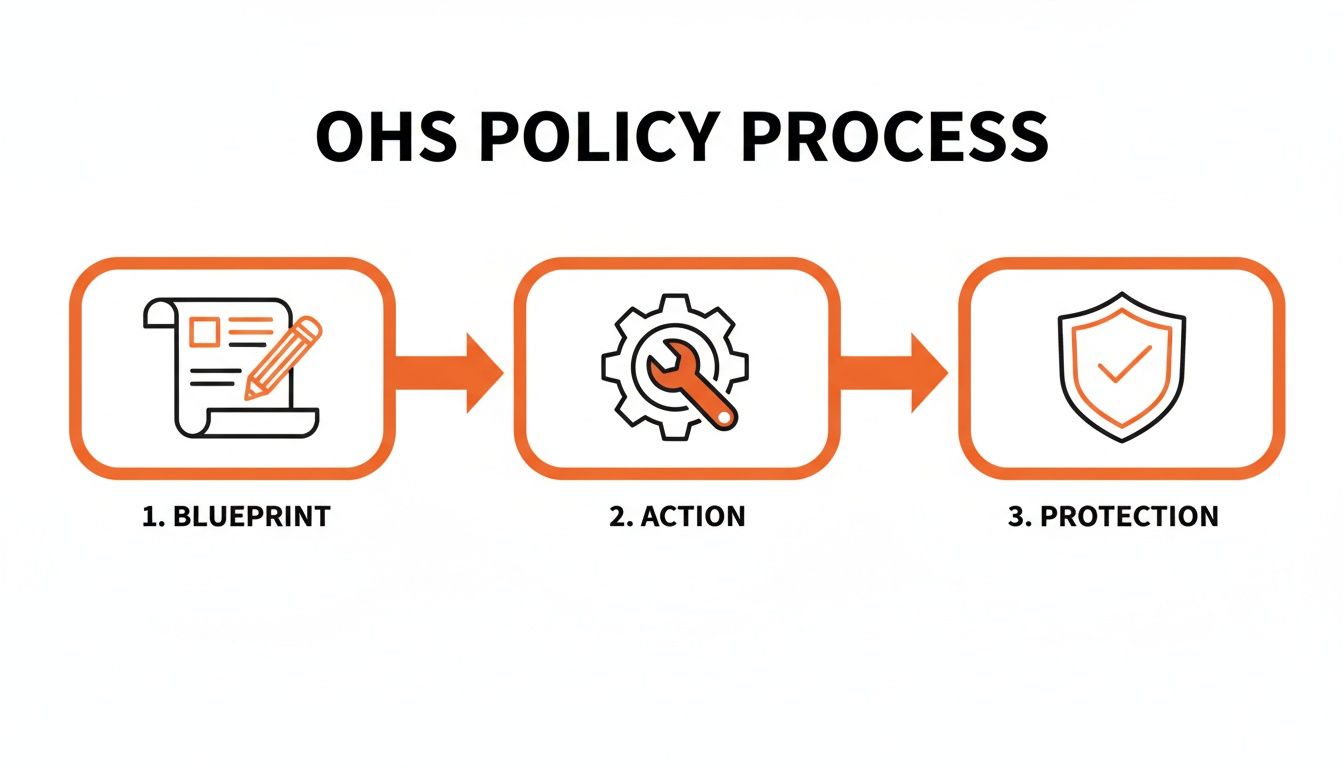
Think of it as a simple, three-step journey from a plan on paper to genuine, on-the-ground protection for your crew.
This process shows how a policy starts as a blueprint, translates into specific actions, and results in real worker protection.
Start With Your Real-World Risks
Before you write a single word, get your hands on your existing risk assessments, Safe Work Method Statements (SWMS), and incident reports. These documents are a goldmine of information about the actual hazards present in your operations. A generic template downloaded off the internet won't know about that one unguarded machine in the workshop or the unique access challenges on your current high-rise project.
Your policy must directly address the dangers most likely to cause harm in your specific environment. While the workplace fatality rate has seen a 24% decline since 2014, the hard truth is that around 80% of fatalities still happen in high-risk industries. The leading causes are vehicle incidents (42%) and falls from height (13%), which is exactly why your policy must be tailored to your hazards, not someone else's.
What Every Good Policy Needs
To be effective, your OHS policy needs a solid structure. It should clearly outline commitments, roles, and what to do when things go wrong. While you'll use your own words, every robust policy should contain these fundamental sections.
Below is a quick breakdown of the essential components you need to include. These aren't just tick-box exercises; they form the backbone of a system that keeps people safe.
| Policy Section | Purpose | Example Focus for Construction |
|---|---|---|
| Management Commitment | A clear, top-down statement of dedication to safety, signed by senior leadership. | Signed by the CEO, explicitly mentioning commitment to zero falls from height and providing all necessary fall protection equipment. |
| Aims & Objectives | Specific, measurable safety goals. | "Reduce manual handling injuries by 15% this year by introducing mechanical aids for all blockwork and reinforcing steel." |
| Responsibilities | Defines who is accountable for what, from the director to the apprentice. | Site Manager: responsible for daily pre-starts. Workers: responsible for reporting all near misses immediately. |
| Consultation | Explains how workers will be involved in safety decisions. | Details on monthly toolbox talks, the role of Health and Safety Reps (HSRs), and the process for raising safety concerns. |
| Hazard Management | Outlines the process for identifying, assessing, and controlling risks. | Covers the use of the hierarchy of control for tasks like working at heights, electrical work, and trenching. |
| Incident Reporting | A clear procedure for what to do when an incident or near-miss occurs. | Step-by-step instructions for immediate reporting to a supervisor, securing the scene, and participating in the investigation. |
| Training & Induction | Details how safety knowledge is shared and verified. | Covers site-specific inductions for all contractors, refresher training on high-risk work, and verification of competency (VOC). |
| Policy Review | Sets a schedule for keeping the policy current and effective. | A commitment to review the policy annually, or immediately following a serious incident or a change in WHS legislation. |
Essentially, your policy is there to provide simple, clear answers. If it doesn't, it isn't ready.
A good policy should answer three simple questions for any employee: What are we trying to achieve? What is my role in that? And what do I do if something goes wrong?
For those just getting started, seeing a well-structured example can be a huge help. You might find our guide on policies and procedure templates useful to see how these clauses fit together in practice.
Use Simple, Direct Language
This is crucial. Avoid overly formal or complex language that nobody will actually read. The goal is communication, not confusion. Use short sentences and simple words.
Instead of this: "The organisation shall endeavour to mitigate all identified workplace hazards through the systematic implementation of control measures congruent with the established hierarchy of controls."
Try this: "We will fix any hazards we find. We'll always try to eliminate the risk first. If we can't, we'll use other controls to keep you safe."
The second example is direct, easy to understand, and far more likely to be remembered and followed on the workshop floor or construction site. Your occupational health and safety policy is a tool for your workers, so write it for them.
Putting Your OHS Policy Into Action on Site
A freshly drafted occupational health and safety policy is full of potential, but it’s completely useless sitting in a folder on a server. Its value is zero until it actually changes how people work on the ground. This is the most critical step in the whole process: turning your written commitments into daily, automatic actions.
This is where so many businesses stumble. They spend weeks, sometimes months, perfecting the document but then fail to map out a clear plan for rolling it out. A successful implementation isn't just about sending a company-wide email. It's a deliberate process of communication, training, and weaving the policy into the rhythm of your daily work.
From Document to Daily Practice
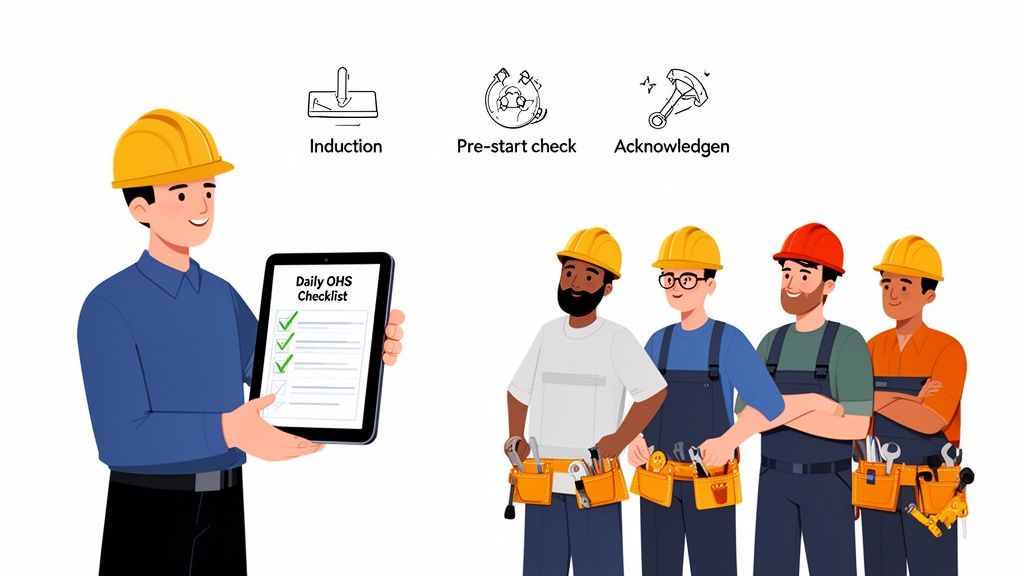
The real goal here is to embed the policy’s principles into your site operations so they become second nature. Think about everything from site inductions to pre-start checks; the policy needs to be present in all of them. The key is making it visible, accessible, and relevant to every single worker, especially subcontractors who might only be on-site for a day or two.
A chaotic, unplanned rollout just creates confusion and, worse, sends a clear signal that safety isn't a genuine priority. A structured, methodical approach, on the other hand, ensures everyone gets the same message and understands exactly what’s expected of them.
Your policy isn't truly 'live' until the newest apprentice on site can explain how it affects their work. If they can't, your implementation isn't finished.
This means you’ve got to move beyond just passive communication. You need to actively engage your team, turning the policy into a practical tool they use every day, not just a document they signed off on once. A great way to start is by incorporating practical Top Workplace Health and Safety Tips that help translate those high-level rules into tangible actions that keep people safe.
Your On-Site Implementation Checklist
Getting your policy off the page and onto the site requires a methodical approach. It’s the only way to make sure no one is missed and that the policy becomes a consistent standard across all your operations and job sites. Use this simple checklist as your guide.
- Official Launch Meeting: Get all your supervisors and managers in a room. Walk them through the policy's key points, clarify their responsibilities in enforcing it, and give them a chance to ask questions. These people are your champions on the ground.
- Team Toolbox Talks: Don't just read the policy aloud. Schedule dedicated toolbox talks on every site to introduce it to your frontline workers. Focus on what's new, what's changed, and how it directly impacts their daily tasks.
- Update Induction Processes: This is non-negotiable. Your OHS policy must be a central part of your induction for all new employees and subcontractors. A solid site induction template is essential to make sure this vital step is never missed.
- Visible On-Site Communication: Make the policy impossible to ignore. Print key sections like the management commitment and worker responsibilities and post them in high-traffic areas like lunchrooms, site offices, and notice boards.
- Integrate into Daily Checks: Weave the policy requirements directly into your existing paperwork. It can be as simple as adding a checkbox to your pre-start checklist: "Have you reviewed the SWMS for today's high-risk tasks as per our OHS policy?" This creates a direct, tangible link between the policy and the work itself.
Using Digital Tools to Simplify Implementation
Trying to manage this process with paper forms and spreadsheets across multiple sites is an administrative nightmare. It’s nearly impossible to track who has been trained, who has acknowledged the policy, and whether the latest version is even the one being used. This is exactly where a digital safety platform becomes invaluable.
A digital system makes the entire implementation process faster and far more reliable. It gives you a single source of truth, eliminating the risk of outdated versions of your policy floating around on different sites.
Here’s how it works in practice:
- Instant Distribution: You upload the new or updated policy to the platform. Instantly, it’s available to every single person in your system, from your direct employees to every last subcontractor.
- Trackable Acknowledgements: You can require every user to digitally sign off that they have read and understood the policy before they can complete a site sign-in or access safety forms. This creates an automatic, time-stamped audit trail for your records.
- Linked to Daily Tasks: This is where the real power lies. You can connect the policy directly to action. Within the platform, you can link specific policy clauses to relevant forms. For instance, your SWMS template for working at heights can have a direct link to the section of your policy that outlines your fall prevention rules, making it impossible to miss.
This approach transforms your policy from a static document into an active, breathing part of your daily safety management system. It makes compliance automatic, not just an afterthought.
Weaving Psychological Safety Into Your Policy
The definition of a truly safe workplace has changed. It’s no longer just about hard hats and high-vis vests. Your duties under Work Health and Safety (WHS) laws are crystal clear: you must now protect your team from psychological harm with the same rigour you apply to physical hazards.
This means your occupational health and safety policy needs a serious update. It has to address mental health directly.
Ignoring this isn't just a compliance issue; it's a huge business risk. Failing to manage psychosocial hazards leads to higher absenteeism, lower productivity, and a spike in complex workers' comp claims. A worker isn't truly safe unless they're protected both physically and mentally.
Spotting Psychosocial Hazards on Site
Before you can write a single word of policy, you have to know what you’re looking for. Psychosocial hazards are the parts of work design, management, and social dynamics that can cause psychological harm. And in high-pressure industries like manufacturing and construction, they are far more common than you'd think.
These hazards aren't always as obvious as an unguarded machine, but their impact can be just as severe. They often include things like:
- Excessive Workload: Unrealistic deadlines, not enough crew for the job, or consistently long hours pushing people towards burnout.
- Low Job Control: Workers having little to no say in how their work gets done or the pace they have to keep.
- Poor Support: A lack of backup from supervisors or colleagues, especially when the pressure is on.
- Workplace Conflict: Unchecked bullying, harassment, or ongoing friction between team members.
- Unclear Roles: Workers being unsure of what's expected of them, which creates unnecessary stress and confusion.
The data backs this up. Mental health disorders now account for 12% of all significant workers' compensation claims in Australia. That figure has jumped by 161% in the last decade alone. This tells us one thing loud and clear: safety managers must build mental health risk assessments into their OH&S policies to get on top of psychosocial hazards like work pressure and stress. You can dig deeper into recent work health and safety trends to get the full picture.
Writing Practical Policy Clauses for Mental Wellbeing
Folding psychological safety into your policy isn't about adding fluffy, feel-good statements. It requires specific, actionable language. Simply saying you "support mental health" is meaningless. You have to spell out how you will identify risks, provide support, and respond when issues arise.
A great place to start is with a clear commitment statement right at the top of your policy.
Example Clause: Management Commitment
"[Your Company Name] is committed to providing a work environment that is both physically and psychologically safe. We will actively work to identify and control psychosocial hazards to prevent work-related stress and psychological injury."
A simple declaration like this sets the tone and makes your commitment official.
From there, you need to add specific clauses that turn that commitment into concrete action. These should focus on practical steps and clear procedures that everyone, from the site manager to the newest apprentice, can understand and follow.
Key Clauses to Weave Into Your Policy
Your policy needs to show you have real systems in place. This gives your words credibility and provides a clear roadmap for everyone on site.
1. Psychosocial Hazard Identification and Control
This clause needs to detail how you'll find and fix these risks.
- Sample Wording: "We will include the assessment of psychosocial hazards (e.g., high job demands, low support, workplace conflict) in our regular risk assessments and site inspections. Control measures will be developed in consultation with affected workers and their Health and Safety Representatives (HSRs)."
2. Confidential Reporting Channels
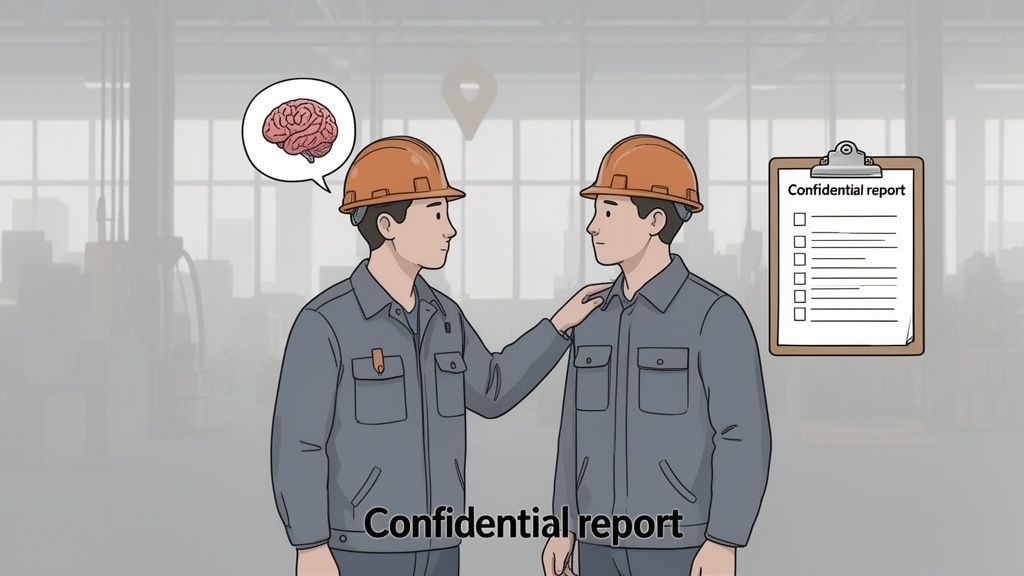
People won't speak up if they fear backlash. Your policy must guarantee a safe way to report issues.
- Sample Wording: "We provide a confidential reporting system for any concerns related to workplace bullying, harassment, or other psychosocial risks. All reports will be investigated promptly and impartially, with confidentiality maintained to the greatest extent possible. No worker will face negative consequences for making a report in good faith."
3. Support Systems and Resources
When someone is struggling, they need to know where to turn. Your policy should point them in the right direction.
- Sample Wording: "We provide access to an Employee Assistance Program (EAP) for confidential counselling and support for work-related or personal issues. Information on how to access the EAP is available in all site offices and through our digital safety platform."
By adding these practical, no-nonsense clauses, your occupational health and safety policy becomes a genuinely useful tool. It moves beyond just physical safety to protect the whole person, which is what a truly safe site is all about.
How to Monitor and Review Your Policy for Real Results
Your work isn't done once the policy is live. An occupational health and safety policy that just sits on a shelf collecting dust is a liability, not an asset. To have any real impact, it has to be a living document that changes with your business, your sites, and the risks your team faces day in and day out.
Setting up a practical monitoring and review cycle is how you keep your policy effective, compliant, and actually preventing incidents. This process isn't about ticking boxes for an annual audit. It's about digging into what's really happening on the ground and using that information to make smart adjustments. A proactive approach turns your policy from a static statement into a dynamic tool for continuous improvement.
Without it, you're essentially flying blind, just waiting for an incident to tell you that something is wrong.
Go Beyond Lagging Indicators
Traditionally, many companies get fixated on lagging indicators like the Lost Time Injury Frequency Rate (LTIFR). While that metric is important, it only tells you how many serious injuries have already happened. To actually get ahead of incidents, you need to track leading indicators: the proactive stuff that stops injuries before they occur.
A balanced approach gives you a much clearer, more honest picture of your safety performance.
- Hazard Reports: How many hazards are your workers spotting and reporting each week? A high number here is actually a good sign. It shows your team is engaged and actively looking for risks.
- Near Miss Reports: Tracking near misses is one of the most powerful things you can do. Every near miss is a free lesson, a chance to fix a problem that could have caused a serious injury.
- Safety Observations: How often are supervisors actually conducting and documenting safety checks on-site? This tracks the frequency of proactive oversight, not just reactions to problems.
- Training Completion Rates: Are all workers, especially your subcontractors, up-to-date with their required training and inductions? This is a direct measure of your procedural diligence.
Tracking these metrics gives you real-time data on your safety efforts. You can spot negative trends and step in before a near miss becomes a serious claim.
Making Reviews Meaningful, Not Just Mandatory
A policy review should be a proper health check, not just a quick read-through to change the date. The real goal is to figure out if the policy is still relevant, effective, and understood by your workforce. A meaningful review involves genuine consultation and a hard look at your safety data.
With 146,700 serious workers' compensation claims lodged in Australia during 2023-24, averaging 400 per day, it's crystal clear that robust monitoring systems are essential. Each one of those claims represents a worker off the job for at least a week, highlighting why you need systems that track everything from near misses to injury trends before they become systemic problems.
A practical review should be triggered by events, not just the calendar.
Schedule a formal review of your occupational health and safety policy at least annually. More importantly, conduct an immediate review after any significant incident, a change in legislation, or when you bring in new high-risk machinery or work processes.
During the review, you have to ask the tough questions. Don't just assume the policy is working because you haven't had a major incident recently.
- Are the responsibilities listed still accurate for current roles?
- Does the policy reflect that new bit of kit we bought six months ago?
- What did our last incident investigation teach us that needs to be added?
- What's the feedback we're getting from workers during toolbox talks?
This process is all about gathering information from every source to strengthen your safety framework. For instance, getting real results from your OHS policy often means using a thorough commercial building inspection checklist to regularly assess safety and compliance on site.
Using Digital Systems for Data-Driven Decisions
Trying to monitor all these KPIs and manage reviews using spreadsheets and paper forms is a nightmare. It's inefficient and riddled with errors. You end up with outdated data, making it impossible to see the real-time picture of what’s happening across your sites.
This is where a digital platform gives you a massive advantage.
Using a system like Safety Space centralises all your safety data, from incident reports to site inspections. It gives you instant access to the information you need to conduct a truly data-driven review.
Here’s what that looks like in practice:
- Real-Time Dashboards: Instead of spending hours manually compiling data, you get live dashboards that show your leading and lagging indicators. You can immediately spot if hazard reporting has dropped off at a particular site or if a certain type of near miss is becoming more frequent.
- Automated Audit Trails: A digital system automatically logs every policy acknowledgement, training completion, and inspection report. This creates an airtight audit trail, making it simple to verify compliance and demonstrate due diligence. Our guide on audits and compliance explains how this simplifies the whole process.
- Informed Decision-Making: With accurate, up-to-the-minute data, you can make decisions during your policy review based on hard evidence, not guesswork. You can pinpoint exactly which sections of the policy are working well and which ones need a rewrite.
This approach transforms your review process from a reactive, compliance-focused chore into a proactive, strategic activity that directly makes your workplace safer.
Your OH&S Policy Questions, Answered
When it comes to building and managing an occupational health and safety policy, the same practical questions come up time and again. Managers in construction and manufacturing need direct answers, not vague advice.
Here are the straightforward answers to the questions we hear most often from people on the ground.
How Often Should We Review Our OHS Policy?
As a rule of thumb, you need to pull your policy out for a full review at least once a year.
But don’t just mark a date on the calendar and forget about it. A policy that just sits on the shelf gathering dust is useless. It has to be a living document that actually reflects what’s happening in your business right now.
You absolutely must trigger an immediate review whenever something significant changes. This isn't optional. Think about situations like:
- After a serious incident or even a significant near-miss. This is a non-negotiable.
- When WHS legislation or codes of practice are updated.
- Before you bring in new high-risk machinery or change a critical work process.
- If your team tells you it’s no longer working. Listen to them.
Treating your policy this way keeps it relevant and genuinely useful for preventing injuries on site, rather than just being a document for compliance.
What’s the Difference Between a Policy and a Procedure?
This is a classic point of confusion, but the distinction is actually pretty simple once you get it.
Your occupational health and safety policy is your high-level promise. It’s your company’s public commitment to safety, spelling out the ‘what’ and the ‘why’. It sets the direction.
Policy Statement Example: "We are committed to identifying and controlling all workplace hazards to prevent injury and illness."
A procedure, on the other hand, is the ‘how’. It’s the gritty, step-by-step instruction manual that your team follows to make that policy statement a reality. It’s the practical, on-the-ground stuff.
Procedure Example: A 'Hazard Reporting Procedure' would detail the exact steps a worker must take: 1. Immediately tell your supervisor. 2. Fill out Form H-01. 3. Help with the risk assessment.
Your policy is the foundation; the procedures are the actions you build on top of it. You need both.
How Do I Get My Crew to Actually Follow the Policy?
Look, if you think emailing a new policy to the team and ticking a box is going to work, you’re in for a rough time. It’s a guaranteed recipe for failure.
Real buy-in doesn't come from a memo. It comes from getting your people involved and making safety a visible, non-negotiable part of the job itself.
First, consult your team while you’re writing it. People take much more ownership when they’ve had a say in creating the rules they have to follow. Second, you have to weave the policy into daily work routines. Talk about it in inductions, toolbox talks, and pre-start checks. Make it impossible to ignore.
And finally, lead from the front. When the team sees that managers and supervisors take the policy seriously, and that the rules apply to everyone, they’re far more likely to get on board.
Is a Generic OHS Policy Template Good Enough?
In a word: no. A template can be a decent starting point to see how a policy should be structured, but it is never enough for real compliance or effective safety management.
Your policy has to be specific to your business and address the unique risks your team faces every single day.
A generic download won't know about that specific press in your factory, the tight access on your construction site, or the particular chemicals you handle. Regulators can spot a copy-pasted policy a mile away. It immediately signals that safety is just a paper-shuffling exercise for you, not a genuine commitment.
You have to put in the work to customise any template to reflect your actual operations.
Managing your occupational health and safety policy doesn't have to be a battle with paperwork and spreadsheets. Safety Space gives you a single platform for real-time monitoring, ensuring every worker and contractor has access to the latest policy. See how it works by booking a free demo.
Ready to Transform Your Safety Management?
Discover how Safety Space can help you implement the strategies discussed in this article.
Explore Safety Space FeaturesRelated Topics
Safety Space Features
Explore all the AI-powered features that make Safety Space the complete workplace safety solution.
Articles & Resources
Explore our complete collection of workplace safety articles, tools, and resources.